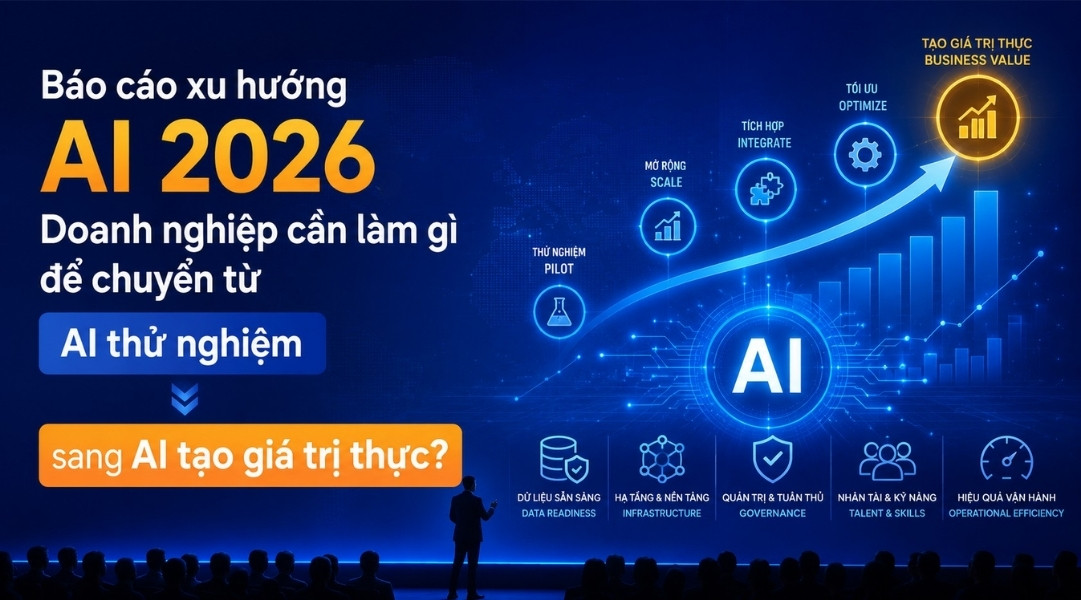
Against the backdrop of a highly volatile global economy, businesses are facing a strategic crossroads: on one side is the urgent need to maintain resilience against external shocks, while on the other is the pressure to innovate so they are not left behind in the artificial intelligence (AI) race.
This article takes an in-depth look at this strategic tension, the 2026 AI trend report, the current state of AI implementation, and the roadmap for organizations to become AI-fueled organizations.
2026 AI trend report: The strongest wave of IT spending in three decades
Since 1996, the world has not witnessed a wave of Information Technology (IT) spending as strong as it is today. This surge is not only the result of conventional digitalization, but also preparation for AI infrastructure on a global scale.
According to the 2026 AI trend report, by 2027, spending on AI infrastructure will account for as much as 14.9% of the total USD 5 trillion IT market. Looking back, we have gone through many phases: from the New Economy of the 1990s, the Dot-com crisis, the era of data analytics, the rise of Cloud and Mobile, to the post-COVID-19 recovery period.
Now, we are at the peak of the “AI infrastructure wave,” where technology is no longer merely a support tool but has become the backbone of every business activity.
The strategic tension for leaders: Stability or breakthrough?
Today’s CEOs are facing a harsh reality. On one hand, they must contend with a wide range of pressures on business stability, such as inflation, tariffs, supply chain disruptions, tighter regulations, geopolitical conflicts, skills shortages, and recession risks. According to the 2026 AI trend report, as many as 56% of business leaders currently consider geopolitical instability the top technology-related threat.
On the other hand, nearly all CEOs believe AI will create opportunities to completely restructure their business models within the next 3–5 years. This creates strategic tension: How can businesses both protect themselves from risks and invest aggressively in new operating models, partner ecosystems, and new ways of engaging customers?
2026 budget strategy: Prioritizing stability to create momentum for breakthrough
Survey data on 2026 budget priorities shows a clear shift toward risk management and operational stability to build the foundation for large-scale AI deployment:
Cybersecurity, resilience, and compliance (42%): This is the top priority as digital threats become increasingly complex.
AI initiatives and projects (41%): Investment in AI remains a key priority, immediately after cybersecurity.
IT infrastructure and operations optimization (39%): To run AI effectively, the underlying systems must operate smoothly.
Disaster recovery for data centers and Cloud (37%): Ensuring data continuity.
Application development and deployment platforms (35%): Building the tools needed to turn innovative ideas into reality.
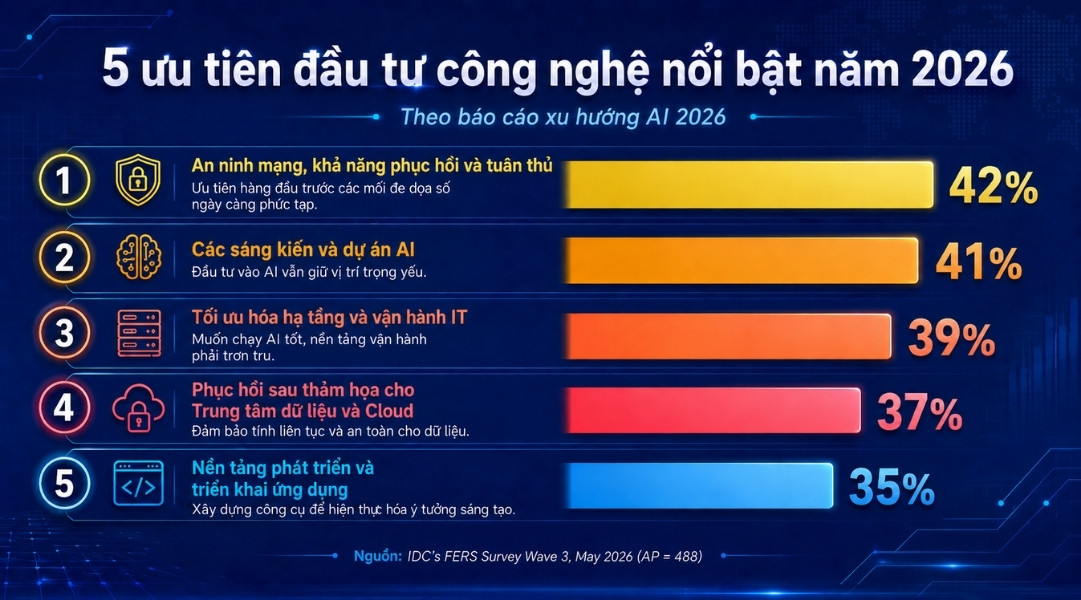
2026 AI budget strategy
See also: WorkGPT ZaloTeam updates new features – Saving 90% of operating time for sales teams
The AI paradox: High expectations but limited real-world impact
Despite very high expectations, AI implementation in practice is still facing many obstacles. Only 11% of organizations report achieving measurable business outcomes from AI initiatives. Most businesses are still struggling with a cycle of technical and operational challenges.
Key barriers preventing AI from scaling
To scale AI successfully, businesses must solve four major challenges:
Data readiness (57%): Poor-quality data, siloed data, lack of metadata, and fragmented data flows are the biggest barriers.
Infrastructure (55%): A lack of AI-optimized hybrid/multicloud systems and performance bottlenecks when handling heavy workloads.
Governance and ROI (54%): Constantly changing regulations, the absence of centralized AI KPIs, and a lack of cost transparency make it difficult to prove value.
Talent and implementation (50%): Skills gaps among development teams, misalignment between partners and businesses, and a lack of post-implementation sustainability.
Technical debt and workflows
According to the 2026 AI trend report, many modernization efforts today are only partially successful, leaving behind a large amount of technical debt (Tech Debt). At the same time, organizations are becoming overloaded by the need to integrate new technologies and reimagine entire workflows. In the Asia-Pacific region, AI and digital projects are typically delayed by an average of around 9 months.
Roadmap to becoming an AI-fueled organization
To move beyond the experimentation stage, businesses need to clearly identify their position within a five-stage maturity model:
Ad hoc stage (2023–2024): AI projects are still fragmented and largely experimental
Opportunity capture stage (2025): Businesses begin identifying specific opportunities, but implementation remains localized
Repeatable stage (2026–2027): AI processes begin to be standardized and aligned with the overall strategy
Managed stage (2028–2029): AI is deeply integrated into operations with close governance
Optimized stage (After 2030): AI becomes a core foundation, enabling comprehensive automation and intelligent operations across the organization
In the Asia-Pacific region, most businesses (58.2%) are still in the opportunity capture stage, while only 0.2% have reached the optimized level. This indicates enormous growth potential if businesses can remove bottlenecks related to people, technology, and governance
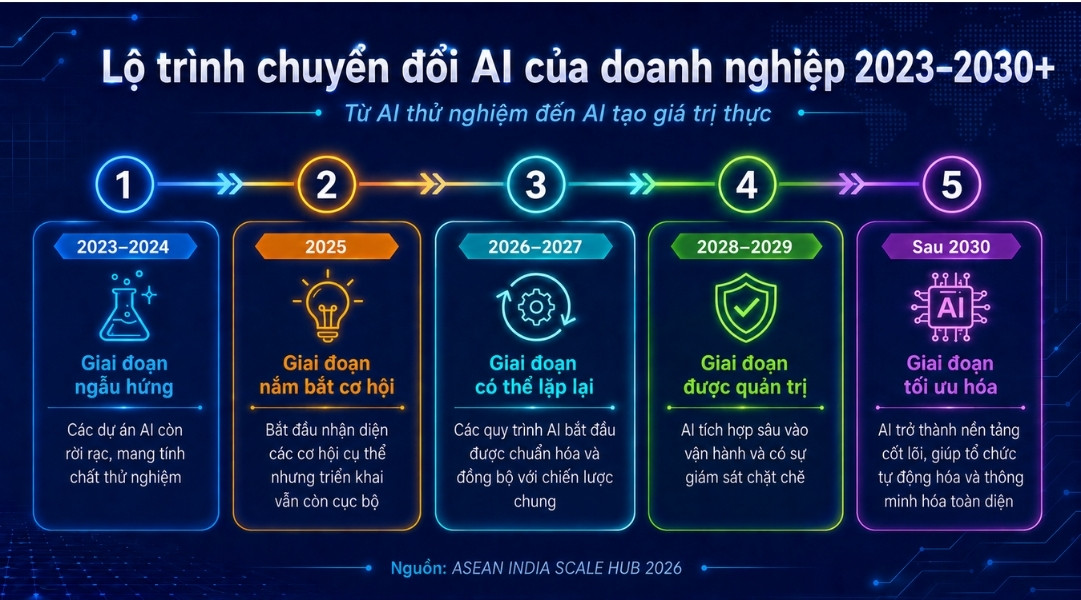
Roadmap to becoming an AI-fueled organization
The partner ecosystem is changing to adapt to new technologies
In the AI era, the relationship between businesses and technology partners is also undergoing profound changes. Value is being redistributed from traditional services toward specialized AI and data services.
Growth in AI budgets does not mean that spending will automatically flow through traditional distribution and resale channels. Surveys show that around 58% of technology partner revenue now comes from products and services they own themselves. Meanwhile, the factors rated most highly for determining future success include:
Technology partner brand strength (54%)
R&D activities (41%)
Marketing (39%)
Transformation capabilities and AI-based service delivery (33%)
This shows that technology companies need to gradually move from simply reselling and implementing solutions toward developing their own products, specialized AI services, and solutions directly tied to customers’ business outcomes.
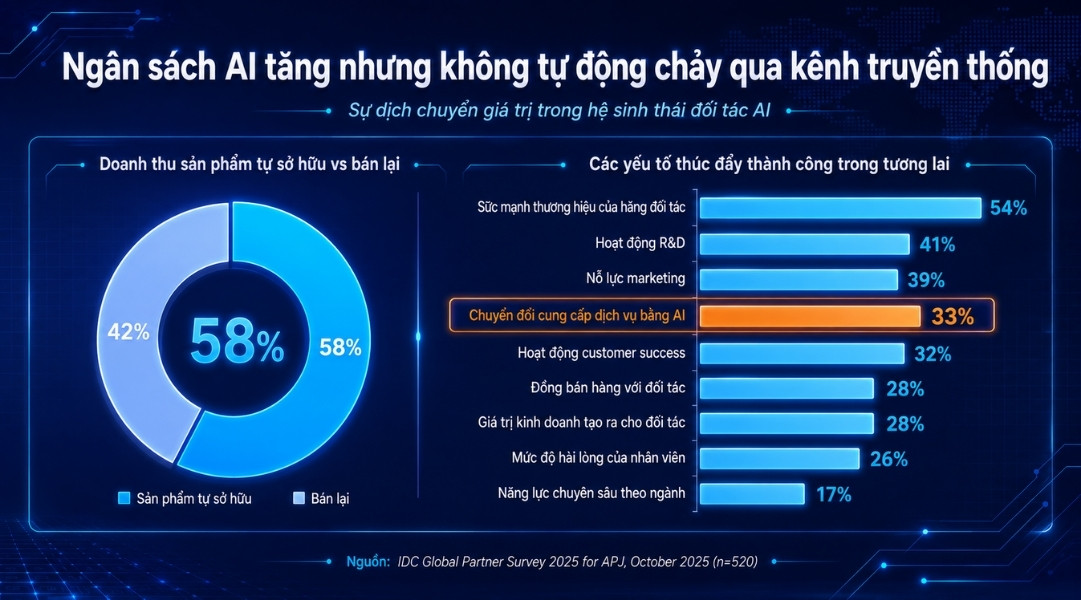
The partner ecosystem is changing
The future of the digital economy and key execution levers
We are entering a new hypergrowth cycle in which “artificial intelligence agents” (AI Agents) will play a central role. By 2029, it is forecast that around 1.2 billion AI agents will be active, carrying out hundreds of billions of actions every day.
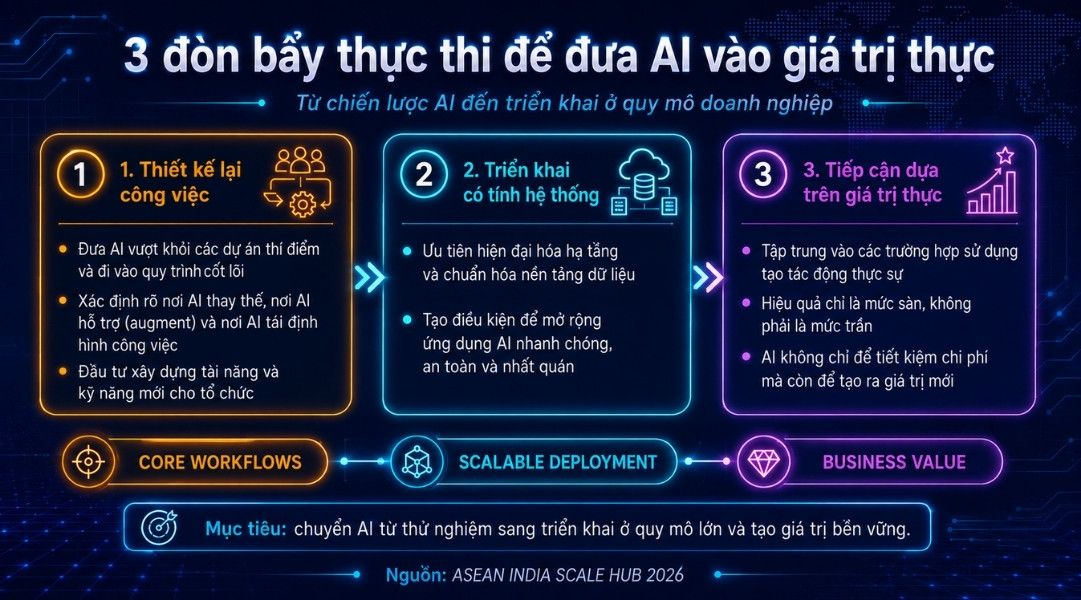
To capture this opportunity, businesses need to focus on three key execution levers:
Redesign work: AI must move beyond pilot projects and be embedded into core processes. Businesses need to clearly define where AI will replace tasks, where AI will augment people, and where AI will completely reshape work. At the same time, building new talent and skills is essential.
Deploy systematically: Prioritize infrastructure modernization and data platform standardization so AI applications can be scaled quickly and securely
Take a value-driven approach: Focus on use cases that create real impact. Remember: “Efficiency is only the floor, not the ceiling.” AI is not only about saving costs, but also about creating entirely new forms of value.
AI hypergrowth cycle and the token economy
See also: INNOCOM officially becomes a Microsoft partner – expanding digital solution capabilities for Vietnamese businesses
The AI era is not for organizations that stand still. The tension between maintaining resilience and driving innovation is an inevitable part of transformation. By focusing on data readiness, infrastructure modernization, and decisively redesigning workflows, businesses can navigate the “AI pivot” and become leaders in the future digital economy.