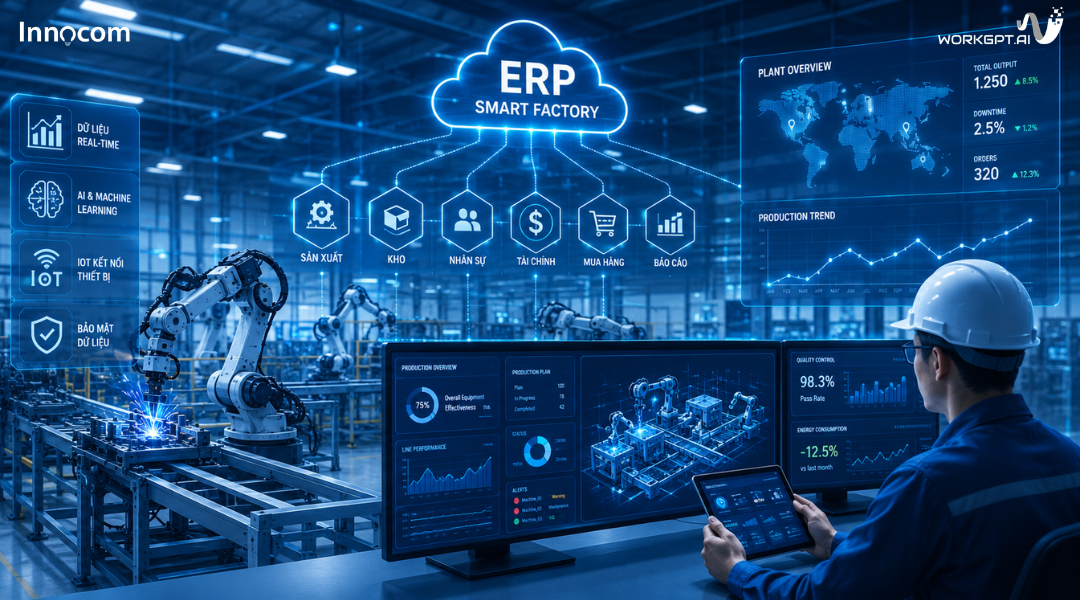
Applying a smart factory model integrated with artificial intelligence (AI) and an ERP system is becoming an inevitable trend that helps manufacturing enterprises reshape their competitive capabilities in 2026. The outstanding development of technology requires managers not only to stop at digitizing static processes, but also to seamlessly connect data from the office directly to the smart factory floor.
The article below will provide readers with a comprehensive view of the Smart Factory AI ERP solution - from the concept and core benefits to the 7-step standardized implementation roadmap that helps optimize operating costs.
Implementing smart factory and the current need for digital transformation
In the context of the market facing a "synchronized cluster" of macro pressures, including fluctuations in raw material costs (30%), supply chain disruptions (28%), inflation (33%), rising energy costs (34%) and a shortage of highly qualified personnel (34%), building a smart factory model is no longer a story of the future. To survive and develop, enterprises are required to make digital transformation a core operational priority of the smart factory.
Actual data from the Rockwell Automation report shows a strong wave of smart factory adoption worldwide:
Large-scale implementation stage: Only 18% of enterprises remain at the pilot stage, while as many as 59% of enterprises have proactively adopted smart factory tools to directly support daily operations.
Strong technology budgets: Manufacturers are committed to long-term investment in smart factory by allocating an average of up to 28% of their operating budgets to digital technologies.
The biggest bottleneck of traditional factories today is not a lack of technology, but the waste of smart factory data resources. Despite continuously collecting huge amounts of raw data from sensors and machinery, the alarming reality is that only 43% of the collected data is effectively exploited and used.
This is precisely why the Smart Factory AI ERP solution on Innocom's ABMS platform was developed, serving as an intelligent intermediary architecture layer that connects, standardizes and transforms all raw data from the factory floor to the office management layer of the smart factory in real time.
3 core benefits from Smart Factory AI ERP that help solve enterprise challenges
Building a smart factory model integrated with ERP is not merely about digitizing raw processes, but about reshaping the entire management capability based on data. Innocom's Smart Factory AI ERP solution thoroughly addresses the 3 biggest challenges that are always top priorities for every production manager:
Improving product quality (top priority for 46% of enterprises)
Product quality is a vital factor for enterprises to maintain the competitive capability of the smart factory. With Innocom's Smart Factory AI ERP, the system is capable of automatically monitoring the smart factory's production process almost instantly at each stage:
Early detection of deviations: The system records progress and defect parameters through QR codes and tablets at the workshop to immediately alert the smart factory's management department.
Optimizing overall equipment effectiveness (OEE): Analyzing historical data to predict potential failures in advance, helping reduce the defect rate and minimize raw material waste in the smart factory.
Optimizing performance and minimizing costs (priority for 40% of enterprises)
Not only automating repetitive tasks, Innocom's Smart Factory AI ERP solution, combined with modern technologies on the factory floor, helps comprehensively optimize smart factory operating costs:
Smart production scheduling: The system links bill of materials (BOM), warehouse and production order data to coordinate smart factory resources smoothly.
Predictive equipment maintenance: AI analyzes abnormal signals from machinery to automatically create maintenance schedules that prevent unexpected machine downtime, reducing unexpected repair costs for the smart factory.
Minimizing operational risks (priority for 36% of enterprises)
In an environment full of global supply chain fluctuations, the ability to adapt flexibly is the key for a smart factory to survive:
End-to-end supply chain visibility: Smart Factory AI ERP provides a visual dashboard tracking status from quotations and inventory to the smart factory's delivery progress.
Proactive decision-making: Instead of operating under a reactive mechanism (only handling issues after they occur), the system supports smart factory managers in making decisions based on analysis of actual data rather than personal intuition.
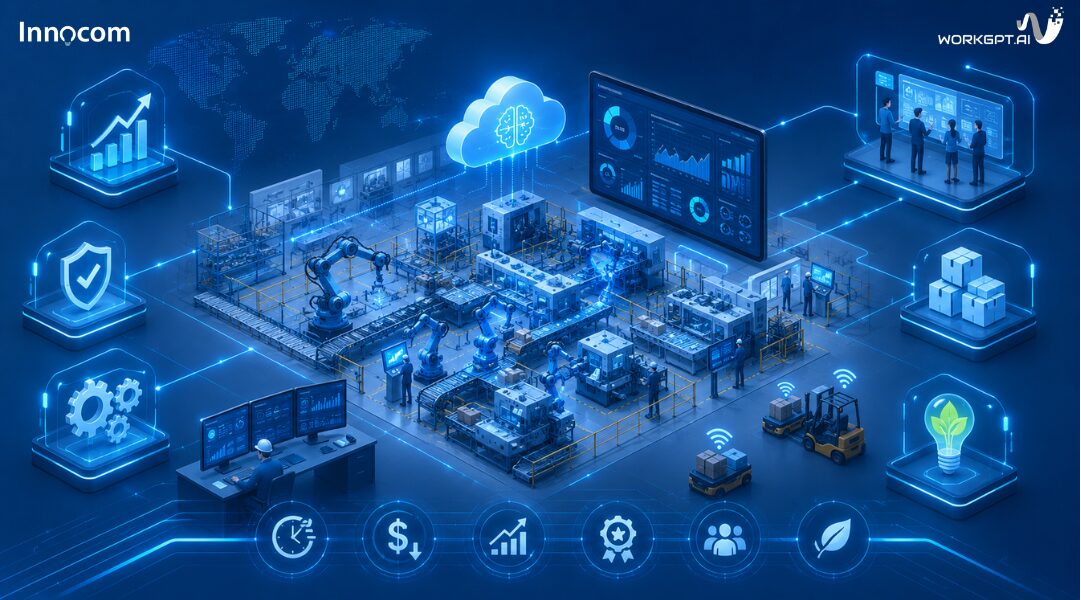
Benefits when enterprises implement Smart Factory
See also: Smart Factory AI ERP: Solution for connecting ERP, AI and production data
Addressing the 4 core capabilities of the modern Smart Factory
To realize the new industrial frontier, the next-generation smart factory model needs to master the 4 core capabilities clearly defined in the Rockwell Automation report. Innocom's solution is designed synchronously to fully address these capabilities:
AI & automation shaping self-optimizing operations
Artificial intelligence (AI) has officially overcome theoretical barriers to deliver clear, practical business results for the smart factory. 48% of global manufacturers consider AI/ML to be the factor delivering the greatest efficiency, significantly outperforming other technologies. Currently, approximately 34% of production activities in smart factory models have been enhanced by AI, and this rate is forecast to increase to 54% by 2030.
Innocom has pioneered the direct integration of the intelligent AI Agent assistant (WorkGPT.ai) into the core operations of the smart factory:
Optimizing purchasing: AI Agent automatically extracts and standardizes quotation data from multiple suppliers and proposes cost-optimized options for the smart factory.
Automatic document digitization: The OCR assistant automatically converts technical drawings, invoices or image-based PDF documents into digital data that is updated directly into the smart factory system.
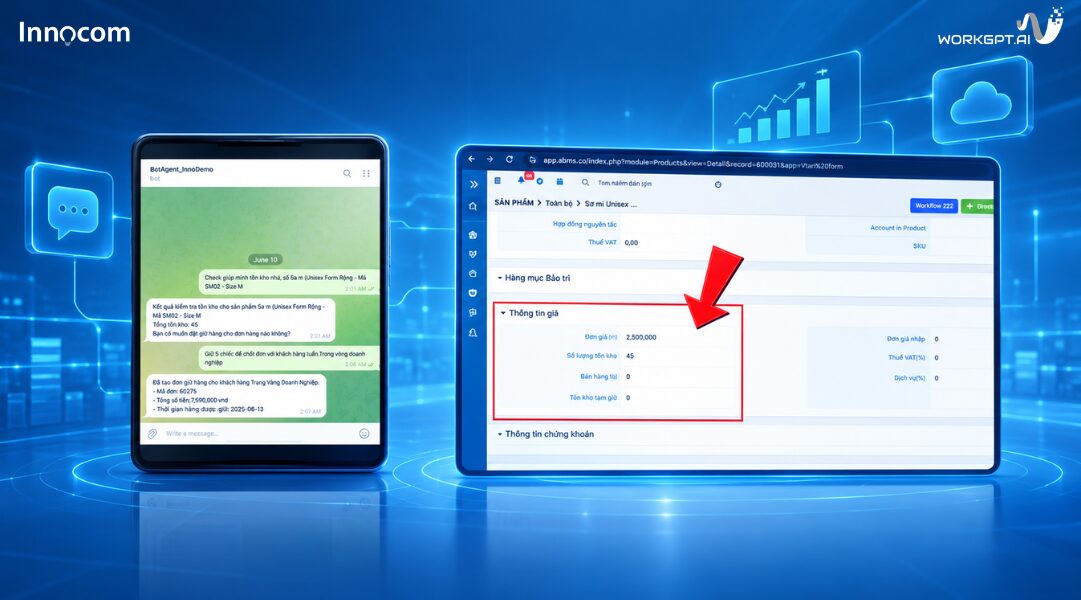
WorkGPT AI helps check inventory and create orders on CRM
Operational Intelligence - Turning data into action
Smart Factory is not different because of the number of robots, but because of how data is exploited. When 57% of collected data is wasted on paper or in fragmented systems, Operational Intelligence becomes the key to optimizing operations.
ABMS of Innocom operates like flexible “Lego blocks”, allowing enterprises to assemble and connect processes according to their needs.
Connecting the entire data flow: Quotation → Sales Order → Production Order → Project → BOM → Warehouse, helping all departments work on a single source of data.
Near-real-time updates: synchronizing the progress of each stage and eliminating manual and duplicate data entry.
Cybersecurity accompanying comprehensive digital connectivity
When connecting the entire system from machinery on the factory floor to ERP management software in the cloud, enterprises must face an unavoidable challenge: cybersecurity risks.
46% of manufacturing enterprises admit that they have experienced at least one cybersecurity incident within the past 12 months.
The connection and integration points between the IT layer (office systems) and OT (factory machinery systems) are identified as the second most vulnerable area to attacks across the entire infrastructure.
When enterprises deploy a smart factory ai erp solution to move toward an autonomous operating model and automated decision-making, security is no longer an additional option but a prerequisite. An autonomous system can only operate safely and reliably when it is built on a strong security architecture platform, capable of comprehensive monitoring and rapid recovery after incidents.

Cybersecurity accompanying comprehensive digital connectivity
See also: ISA-95 standard: A comprehensive bridge in modern manufacturing
Redefining the role of human resources through AI Agent assistants
One of the clearest trends of the modern smart factory is the redefinition of the workforce. As many as 93% of manufacturers expect to reshape their workforce structure as smart factory technologies develop, and 40% of enterprises have already conducted reskilling for employees within the past year.
In Innocom's smart factory system, AI Agent is designed to support and enhance workers' decision-making capabilities rather than replace them:
Human-in-the-loop principle: AI Agent acts as an intelligent assistant supporting project information lookup and hands-free data extraction directly on the smart factory's internal chat platforms.
Decision-making safety: AI provides in-depth analysis and proposes solutions, while important approval decisions remain under the final control of humans, creating a perfect combination of human insight and machine accuracy in the smart factory.
The 8-step roadmap for the most successful Smart Factory transformation
To successfully transform to a smart factory model integrated with AI ERP and avoid ineffective technology investment traps, enterprises can refer to the following practical 8-step roadmap:
Prove real value before technology: Select and prioritize specific use cases that directly address the factory's operational issues.
Prioritize investments with short payback periods: Create value streams quickly to maintain implementation momentum and self-fund subsequent stages.
Plan for scalability: Design an integrated system that works synchronously with the existing platform, ensuring easy scalability in the future.
Promote enterprise-wide collaboration: Break down information barriers between IT and OT departments to unlock the value of data.
Learn, iterate and continuously improve: Maintain a long-term digital vision while always remaining flexible in adjusting the strategy based on practical lessons.
Communicate progress and success: Widely share achieved results to build trust and enthusiasm among the workforce.
Define and apply data governance rules: Strictly comply with the enterprise's data standards and common operating processes.
Equip and recognize human resources: Provide skills training, change working mindsets and empower employees to master new technologies.
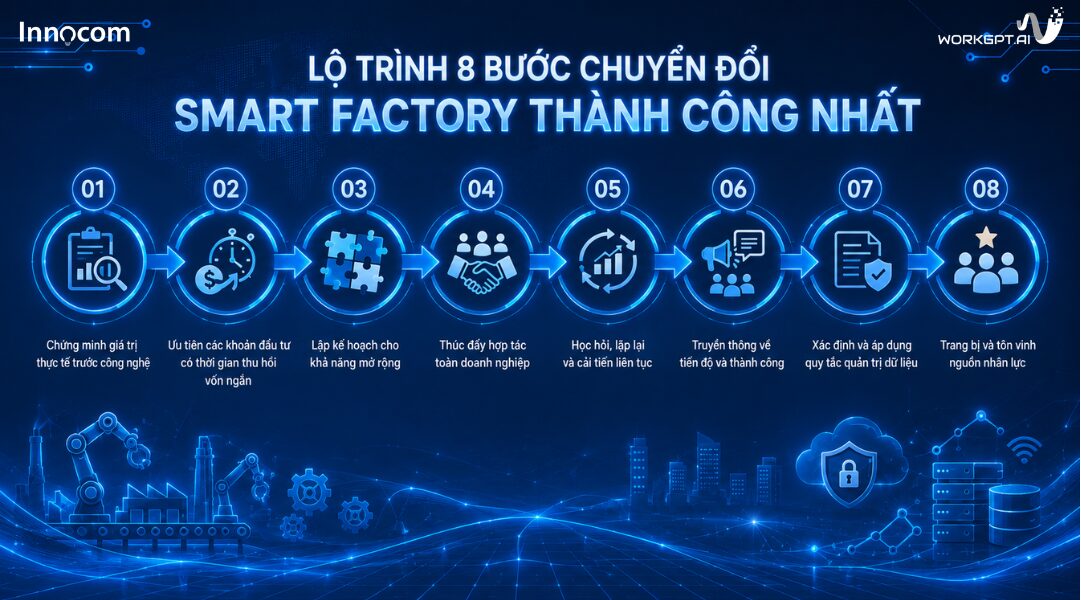
Smart Factory AI ERP implementation roadmap
Investing in the smart factory AI ERP solution on Innocom's ABMS platform is not merely about equipping the enterprise with ordinary management software, but is a strategic transformation that helps manufacturing enterprises abandon traditional passive operating methods. Seamless control of the data flow from the office to the factory floor helps minimize risks, reduce production costs and open up strong breakthrough opportunities for the smart factory.
Start your digital transformation journey today by building a structured roadmap. Contact WorkGPT.AI - Hotline 1900.068.895 today for consultation and a free demo!