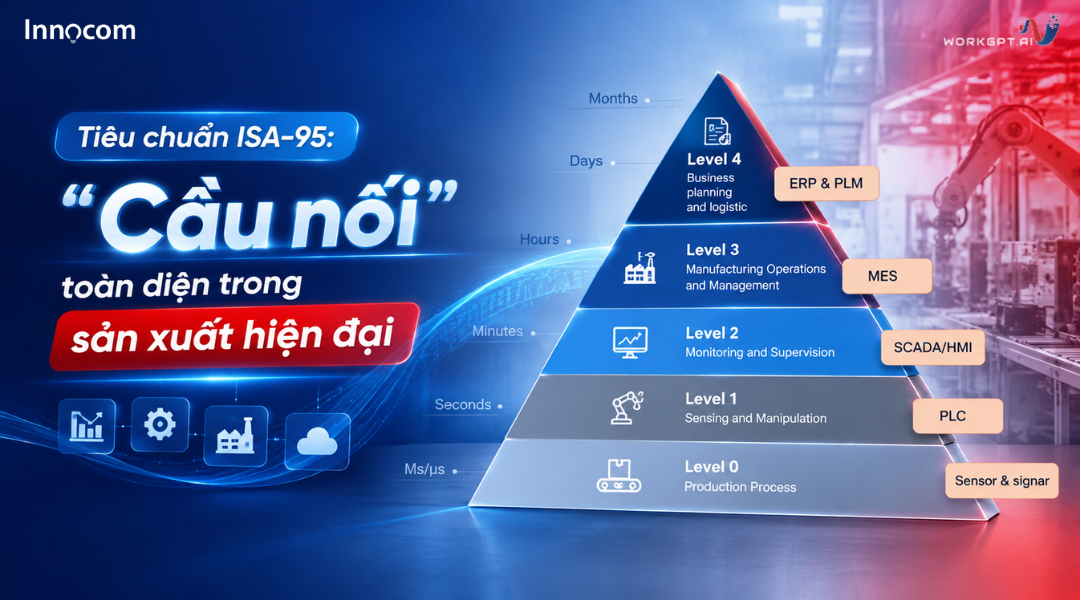
In the era of smart manufacturing and digital transformation, seamless connection between enterprise management levels and factory operations has become a vital factor for the development of every business. To solve the problem of data synchronization, avoid information fragmentation and optimize processes, the ISA-95 standard was introduced as an indispensable international reference framework.
This article will provide you with a comprehensive overview of the definition, 5-level model, detailed structure and role of ISA-95 in the Fourth Industrial Revolution.
1. What is the ISA-95 standard?
ISA-95 (also known as ANSI/ISA-95 or the international standard IEC 62264) is a global standard for integrating manufacturing control systems and enterprise management systems, developed by the International Society of Automation (ISA).
The main objectives of ISA-95 are:
Standardize terminology and information: Create a common language that helps information technology (IT) personnel and factory operations (OT) personnel easily communicate and collaborate with each other.
Build an abstract model: Define a safe, robust and cost-effective data exchange interface between business management functions and production control functions.
Minimize integration risks: Limit errors, reduce costs and risks when implementing connections between different software systems within the enterprise.
Before ISA-95, enterprise management systems (ERP) and manufacturing execution systems (MES) often operated separately, resulting in data silos. ISA-95 was introduced to break down this barrier, creating a solid foundation for the modern connected factory model.
2. ISA-95 automation pyramid model (5 Levels)
The most common and classic model of ISA-95 is a logical hierarchical model based on the Purdue Reference Model. This model divides all technology activities and business processes in a factory into 5 levels from low to high (Level 0 to Level 4):
Level 0: Physical Production Processes
Definition: This is the most basic level, focusing on machinery, assembly lines and actual physical assets operating on the factory floor.
Task: Directly perform production or physical processing activities.
Level 1: PLC - Sensing and Manipulating
Definition: Focuses on smart devices responsible for collecting data and directly acting on the physical process.
Typical devices: Temperature sensors, pressure sensors, current sensors, control valves and other smart devices.
Level 2: SCADA/HMI - Monitoring and Supervising Control
Definition: This is the level responsible for automating, adjusting and directly controlling daily production processes to ensure safety and efficiency.
Typical systems: Programmable Logic Controller (PLC), Distributed Control System (DCS).
Level 3: MOM/MES - Manufacturing Operations Management
Definition: This is considered the most important level in the integration model, responsible for directly managing and operating the entire actual production process.
Typical systems:Manufacturing Execution System (MES) and SCADA monitoring system. This level manages activities ranging from detailed planning, progress tracking and quality management to equipment maintenance.
Level 4: ERP/PLM - Business Planning and Logistics
Definition: Focuses on all necessary business management activities to operate and guide the enterprise.
Typical systems: Enterprise Resource Planning (ERP), responsible for order management, accounting - finance, human resources management and supply chain.
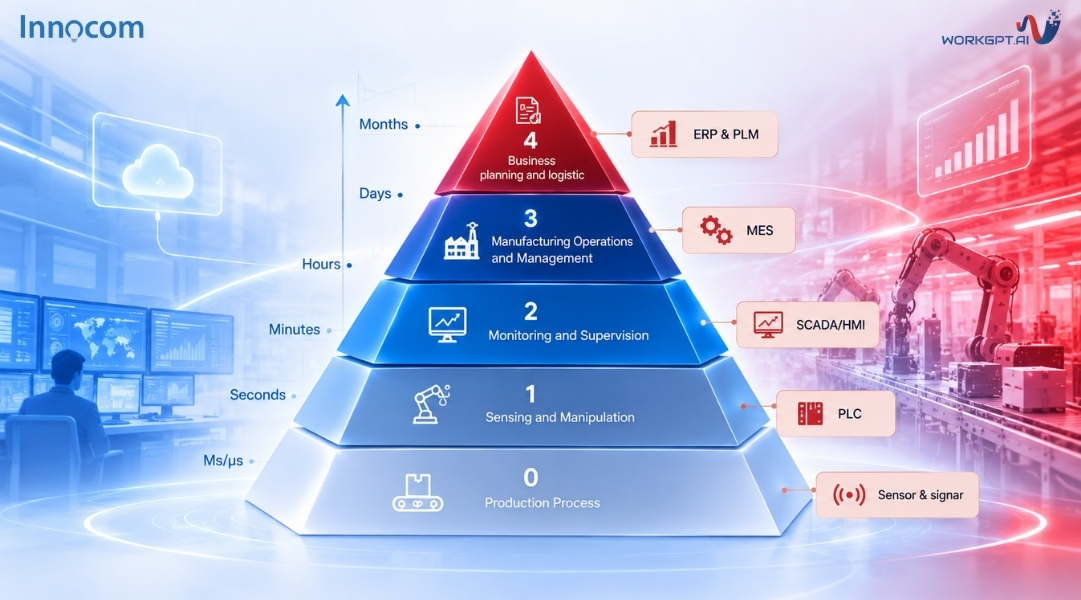
ISA-95 automation pyramid model
See more: Smart Factory AI ERP: Solution for connecting ERP, AI and production data
3. Detailed structure of the ISA-95 standard
The ISA-95 standard is built in an extremely comprehensive manner and includes 8 separate parts:
Part 1 - Models and terminology: Defines the scope of the manufacturing control domain, how physical assets are organized, interface functions and descriptions of information shared between the control and enterprise levels.
Part 2 - Objects and attributes: Identifies the conceptual interface content exchanged between Level 3 manufacturing systems and Level 4 business systems in order to minimize risks, costs and errors.
Part 3 - Activity models: Defines in detail the activity models related to manufacturing operations management (Level 3) and internal data exchange flows at this level.
Part 4 - Objects and attributes for MOM integration: Goes deeper into defining the object models exchanged between Level 3 activities mentioned in Part 3 in order to improve integration capabilities throughout the system lifecycle.
Part 5 - Business-to-Manufacturing transactions: Defines specific information exchange transactions between business applications (Level 4) and manufacturing applications (Level 3) to support data storage, transfer and collection.
Part 6 - Messaging service model: Describes a set of standard messaging services for exchanging information between Level 3 and Level 4 applications, as well as internally within Level 3.
Part 7 - Alias service model: Defines technology-independent services and messages for mapping and linking aliases (equivalent names) and their associated contexts between manufacturing and other domains.
Part 8 - Information exchange profiles: Specifies the method for defining information exchange profiles (including specific nouns and verbs) for practical implementation groups of the ISA-95 model.
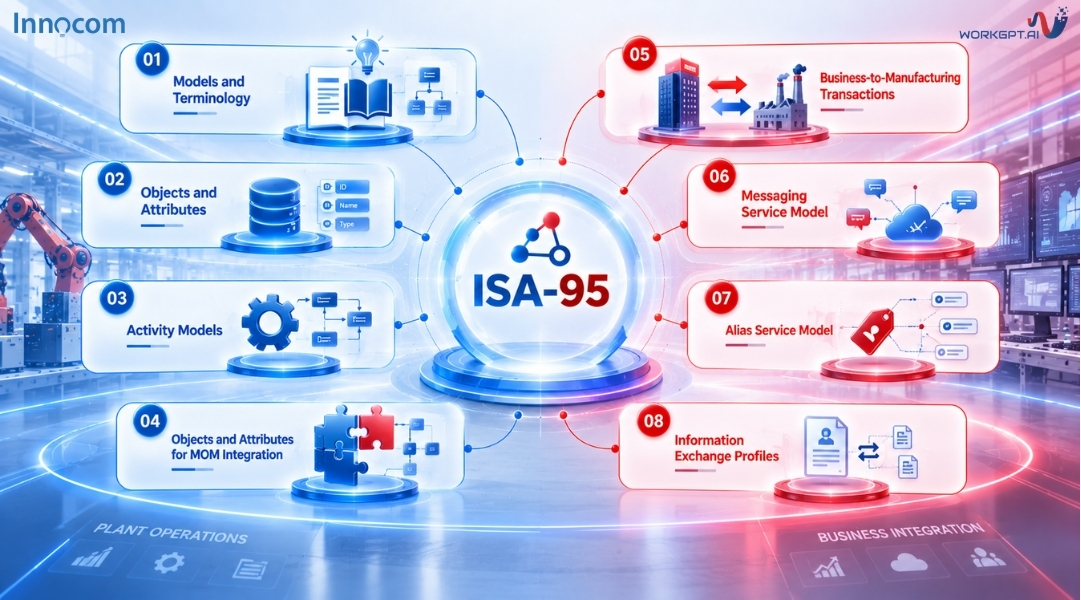
Detailed structure of the ISA-95 standard
4. Is ISA-95 outdated in the era of the Fourth Industrial Revolution?
With the explosion of new technologies such as IoT, Big Data, Cloud and artificial intelligence (AI), the traditional ISA-95 pyramid structure faces several challenges. However, this standard is by no means outdated and is being strongly expanded:
Core values that are still maintained:
Global common language: ISA-95 remains the only standard framework for defining data flows between management and production.
High synchronization: Most of the world's leading ERP and MES providers comply with or use ISA-95 as a reference framework.
Foundation for Smart Factory: Industrial Internet of Things (IIoT) solutions or Smart Factory models still inherit from and expand upon the architecture of ISA-95.
Limitations that need improvement in the context of 4.0:
Flexibility: The original model has a strict hierarchical structure (0-4), while Industry 4.0 aims for a flat, decentralized and direct network connection between machines and people.
Real-time requirements: IoT requires instant data transmission and reception (real-time), while the traditional ISA-95 structure tends to focus on standardized and periodic information flows.
Current trend: To adapt, ISA-95 is being integrated with new technology standards such as OPC UA and the RAMI 4.0 reference model to ensure open and flexible connectivity and real-time data response.
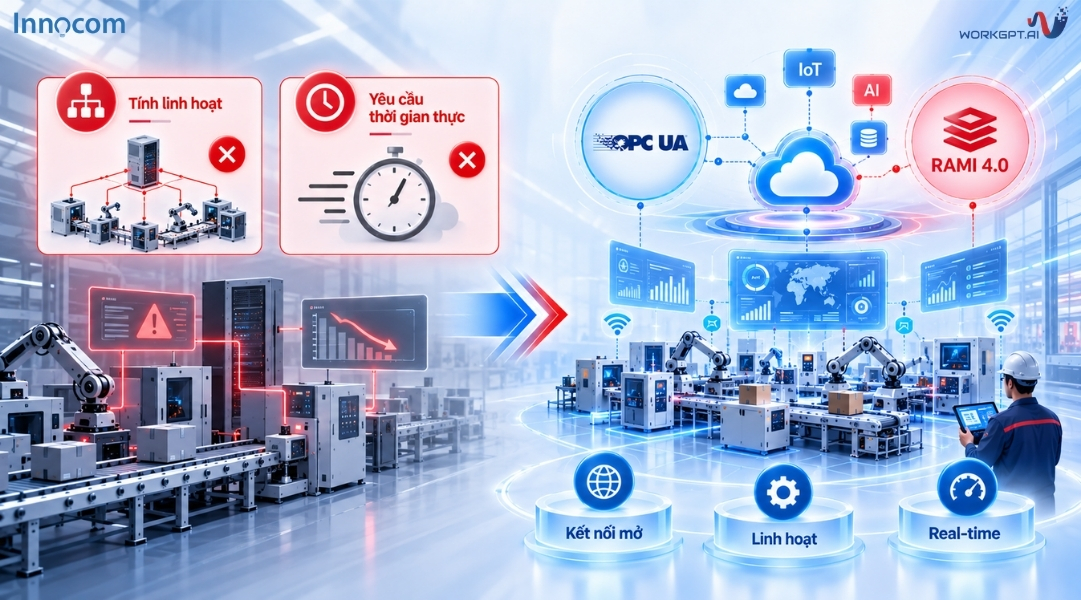
ISA-95 in the era of the Fourth Industrial Revolution
5. INNOCOM - Comprehensive ISA-95-standard digitalization and system integration partner
To implement the ISA-95 standard in actual management and operations processes without encountering data fragmentation barriers, businesses need a technology partner with strong integration capabilities. INNOCOM Technology and Business Consulting Co., Ltd. is a reliable companion with a comprehensive digitalization solution ecosystem:
Consulting and system design according to international standards
With more than 14 years of experience implementing technology projects for thousands of domestic and international partners, Innocom has a team of experts with deep knowledge of system integration, helping businesses develop standardized connection roadmaps between the manufacturing operations level and the enterprise management level, minimizing integration risks and costs.
ABMS - "Lego set" for integrated management
The ABMS system developed by Innocom is an extremely flexible dynamic management platform. Compared to a self-assembling Lego set, ABMS allows:
Unlimited customization: Personalize the management model according to the operational characteristics of each factory.
Superior data connectivity: Easily integrate with all ERP, CRM, database systems and peripheral devices through standardized APIs/interfaces.
Absolute security: The system meets the strict ISO 27001:2013 information security standard, helping operational information flows take place safely and smoothly.
WorkGPT.ai - Accelerating real-time data flows with AI
To solve the problem of "lack of real-time flexibility" in the traditional ISA-95 model in the 4.0 era, Innocom's virtual assistant WorkGPT.ai is the perfect answer. This intelligent AI solution system helps:
WorkGPT.ai OCR: Automatically convert image documents and PDFs into digital text and synchronize them directly into the production data management system or CRM/ERP without manual data entry.
24/7 Chatbot system: Self-learn from internal documents, automate progress reports and instantly send operational incident notifications to the management's internal chat platform within just a few seconds.
Strategic partner of leading global solutions
Innocom is the only officially certified partner of Vtiger CRM in Vietnam and Southeast Asia, and is also an official partner of Sangoma (a leading global Call Center solution). This combination provides the ability to synchronize customer data, business data and factory operational data into a unified whole.
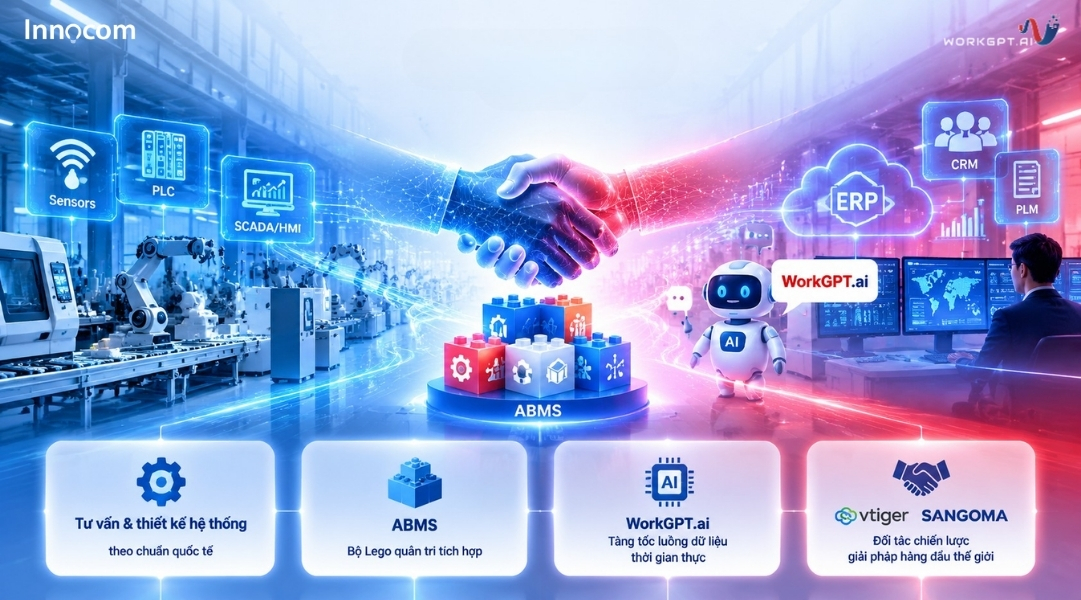
INNOCOM - Comprehensive digitalization and system integration partner
See more: Smart Factory AI ERP: Shaping manufacturing management in 2026
Applying the ISA-95 standard not only helps businesses standardize their information infrastructure but is also a core foundation for building a true Smart Factory. The application of modern manufacturing operations solutions designed in accordance with the ISA-95 standard will be a solid springboard, helping businesses optimize productivity, eliminate operational waste and break through to take the lead in the digital transformation era.
Contact WorkGPT.AI - Hotline 1900.068.895 today to receive a free consultation and demo!