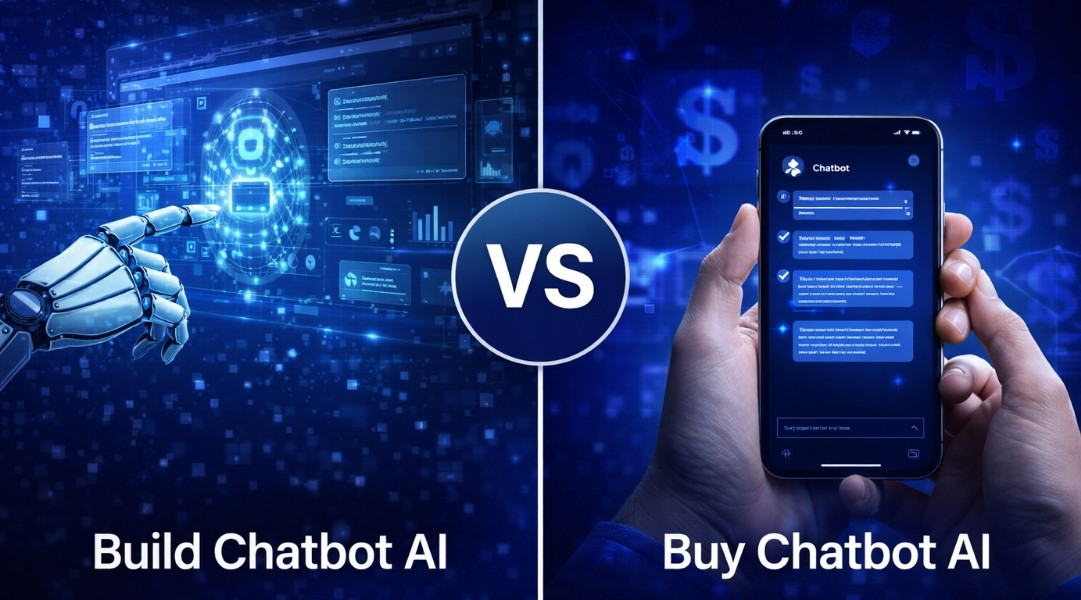
Should SMEs build or buy an AI chatbot to support customers?
In a context where customers expect instant responses, customer service is no longer simply about “replying to messages” but has become part of a growth strategy. AI-powered chatbots are helping small and medium-sized enterprises (SMEs) automate consultation processes, handle repetitive questions, and provide 24/7 support at a more optimized cost than expanding their workforce.
However, an important question arises: Should SMEs build or buy an AI chatbot to support customers? This is not simply a technology decision, but also a matter of long-term strategy, data control, and internal operational capabilities.
This article analyzes each aspect in detail to help businesses make the most suitable choice.
How are building and buying an AI customer service chatbot different?
To answer the question of whether to build or buy an AI chatbot for customer support, it is first necessary to understand the nature of these two approaches.
What does building an AI chatbot mean?
Building an AI chatbot means that a business designs, develops, and operates its own chatbot system. This includes:
Building conversation flows
Integrating artificial intelligence for natural language processing
Connecting with customer and order management systems
Deploying and maintaining the operating infrastructure
The business has full control over the system architecture, data processing methods, response rules, and future scalability.
What does buying an AI chatbot mean?
Buying an AI chatbot means using a ready-made solution provided by a vendor. The business pays based on a package or usage level to deploy the chatbot on websites, social media, or messaging applications.
The provider typically handles:
Server infrastructure
Technology updates
System maintenance
Technical support
The business mainly focuses on configuring content and optimizing the customer experience.
When should SMEs build an AI chatbot?
In reality, building an AI chatbot is not simply about creating an automated response tool. It is a complete technology project that requires specialized personnel, development processes, and long-term operational capabilities.
Below are the conditions businesses need if they want to build their own chatbot.
Already have a complete and specialized technical team
To develop a stable AI chatbot, a business needs at least the following roles:
Software development team: Responsible for system design, building processing flows, integrating with customer management systems, and ensuring the chatbot operates smoothly without errors when traffic increases.
Natural language processing specialist: Responsible for optimizing the system’s ability to understand user intent, improving question classification accuracy, and reducing contextually incorrect responses.
Infrastructure operations personnel: Responsible for managing servers, monitoring system performance, handling incidents, and ensuring the chatbot remains available 24/7, especially during periods of high traffic.
Personnel responsible for optimizing the model based on real-world data: Analyzing conversation data, adjusting response logic, and improving the experience based on actual user behavior.
If any of these links is missing, the system may:
Respond out of context
Operate slowly
Fail to scale as the business grows
Encounter errors that cannot be resolved promptly
For most SMEs, maintaining a complete team like this over the long term represents significant cost and management pressure.

Specialized technical team
See also: WorkGPT AI Zalobot – One AI employee can handle thousands of customers
Already have stable technology infrastructure
Building a chatbot means that the business must take responsibility for:
Data storage servers
Backup and recovery systems
Security and access control mechanisms
Real-time performance monitoring
This approach is suitable if the business:
Already has an internal data center
Already operates large-scale technology systems
Has a technical team available 24/7
If this infrastructure is not already available, the initial setup costs can be much higher than expected.
The chatbot is part of a long-term technology strategy
Building a chatbot is only reasonable when the chatbot is not simply a customer support tool, but rather:
A core component of the product ecosystem
A technology-based competitive advantage
A strategic data processing system for the business
In this case, the business may want to:
Maintain full control over the entire architecture
Proactively upgrade the system according to its own roadmap
Integrate deeply with its own products or platforms
However, this is usually the direction taken by technology companies or organizations with strong digitalization strategies.
Ready to make a long-term investment instead of optimizing for the short term
The cost of building a chatbot is not limited to the initial development cost. Businesses also need to consider:
Annual maintenance costs
Upgrade costs as technology changes
Fixed personnel costs
Costs related to incidents and system downtime
If a business considers the chatbot a long-term technology asset and is willing to invest over several years to gradually optimize it, this option may be suitable.
In contrast, if the goal is to:
Quickly improve customer service
Reduce the workload of the existing team
Optimize efficiency within 6–12 months
Then building the chatbot may not be the most strategically effective choice.
Ready to make a long-term investment
When should SMEs buy an AI chatbot?
In many cases, especially for small and medium-sized businesses with limited resources, choosing a ready-made solution is more practical.
Need to deploy quickly to avoid losing customers
In a highly competitive environment, response speed directly affects revenue.
According to various customer service industry surveys, most users expect to receive a response almost immediately after sending a message.
If a business is experiencing:
Employees unable to respond in time
Customers waiting too long and leaving
Messages being missed outside working hours
Customer service teams becoming overloaded during advertising campaigns
Then rapid chatbot deployment should be an urgent priority.
A ready-made solution helps businesses:
Deploy within a short period
Use existing common conversation scenarios
Avoid development processes that take months
This is particularly important for SMEs in the growth stage.
Want to optimize costs and avoid technology risks
Building a chatbot means higher fixed costs and long-term operational risks. In contrast, buying a chatbot transfers most of these risks to the provider.
Specifically, when purchasing a professional solution, businesses do not need:
A dedicated software development team: No need to recruit and maintain personnel solely to operate a chatbot system.
An internal natural language processing specialist: No need to independently research and optimize contextual understanding because the platform is already trained and continuously improved.
24/7 infrastructure operations personnel: No need to monitor servers, handle overload, or resolve technical incidents.
A specialized conversational data optimization team: No need to manually analyze every conversation flow to improve accuracy.
Instead, businesses pay according to a service package and receive:
Regular system maintenance
Automatic technology upgrades
Technical support when needed
High system stability
For SMEs, this is a clear way to optimize costs and resources.
Need system integration without developing everything from scratch
A common misconception is: “If the process is complex, we have to build the system ourselves.”
In reality, professional chatbot platforms today can:
Connect with customer management systems
Synchronize order data
Handle multi-step processes
Automate post-purchase customer care
Classify customers based on behavior
This means businesses can still:
Customize the chatbot according to their own processes
Design flexible response flows
Personalize the customer experience
Without having to invest in an entire internal technical team.
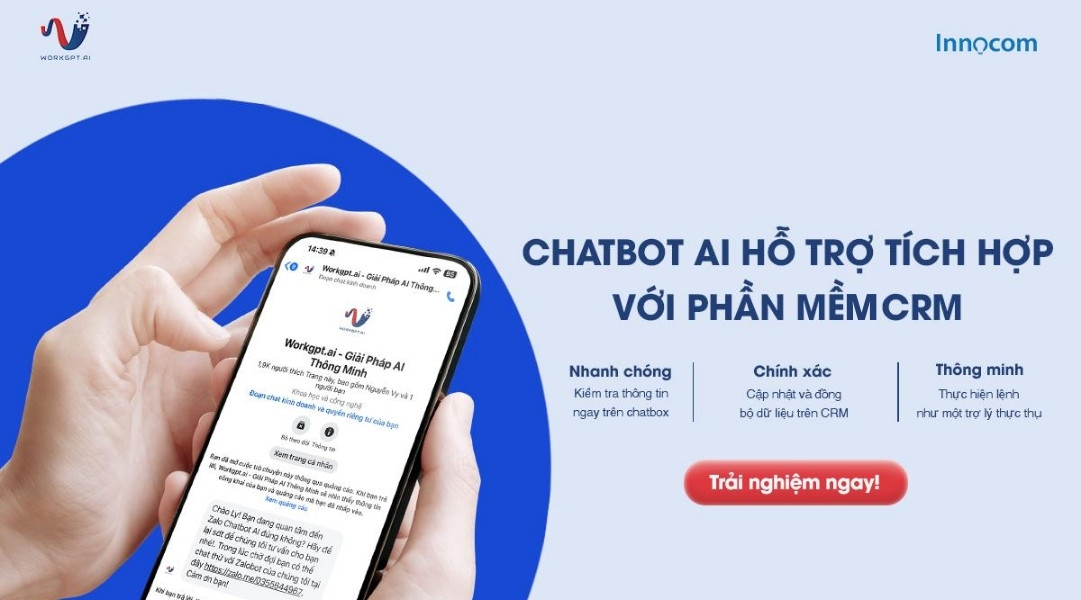
AI chatbot integrated with CRM
See also: WorkGPT Chatbot AI – Smart solution for the tourism industry
Want to focus on business instead of technology operations
SMEs often have limited resources. Every resource allocation decision affects growth.
If too much budget and manpower are dedicated to developing an internal system, businesses may:
Reduce their marketing budget
Reduce investment in sales
Increase management pressure
Buying a chatbot allows businesses to:
Focus on customers and revenue
Leave technology operations to specialized providers
Reduce long-term operational pressure
From a strategic perspective, this is a more efficient way to allocate resources.
Not yet certain about long-term needs
Many SMEs deploying a chatbot for the first time do not know:
How much actual interaction volume they will have
How complex their processes need to be
Whether the automation rate will meet expectations
In this case, making a large investment to build a system from scratch carries significant risk.
Buying a solution allows businesses to:
Experiment at a lower cost
Collect real-world data
Evaluate performance after several months
Adjust their strategy before scaling
This is a safer and more flexible approach.
Factors to consider when deciding whether to build or buy an AI chatbot
Evaluation criteria | Build an AI chatbot | Buy an AI chatbot (ready-made solution) |
Time to launch | Requires time for requirements analysis, design, development, and testing | Can be deployed quickly |
Speed to market | Slower because it must be developed from scratch | Faster by leveraging existing infrastructure |
Initial cost | High (technical team, infrastructure, and system development) | Lower, with package-based pricing |
Long-term cost (3–5 years) | Can be optimized at large scale | Increases based on users, messages, and features |
Data control | Full control over data storage and processing | Dependent on the provider’s infrastructure |
Security & regulatory compliance | Business can establish its own security standards | Dependent on the platform’s commitments |
Customization | Highly flexible and designed around specific processes | Limited by platform features |
Use-case complexity | Handles complex multi-step flows and deep integrations well | Better suited to common scenarios and repetitive questions |
Internal system integration | Deep integration with proprietary management systems | Usually supports common integrations |
Future scalability | Flexible expansion based on self-designed architecture | Dependent on service packages and platform limitations |
Vendor dependency | No external dependency | Dependent on pricing, policies, and development roadmap |
Internal technical requirements | Requires a capable technical team for maintenance and upgrades | No need for a specialized technical team |
Operational risk | Business takes full responsibility | Provider takes responsibility for most operational aspects |
Optimization based on real-world data | Can be deeply customized based on user behavior | Limited by available analytics tools |

Factors determining whether to build or buy an AI chatbot
There is no single answer that works for every business. For SMEs that are just getting started, choosing a ready-made solution often allows them to experiment quickly and reduce risks. As the business grows, greater customization and control may drive the need to build a proprietary system. Most importantly, an AI chatbot should not be viewed as an isolated support tool, but as part of a long-term digital transformation strategy.
Making the right choice from the beginning can help businesses reduce costs, improve customer experience, and establish a foundation for sustainable growth in the future. Contact WorkGPT.ai for consultation and a free demo!