Smart Factory AI ERP is creating a new direction in modern manufacturing management by combining management data, shop-floor data, and artificial intelligence on a unified platform. Although traditional ERP systems have helped businesses standardize data and connect departments from sales and procurement to accounting, simply managing static data is no longer sufficient as factory operations scale. Managers need to keep track of real-time developments at every stage — knowing exactly why a production order is delayed, which project is exceeding its budget, or which materials are at risk of running short in order to make optimal decisions.
This article will help you understand what Smart Factory AI ERP is, how it operates, and the roadmap for effectively implementing it in your business.
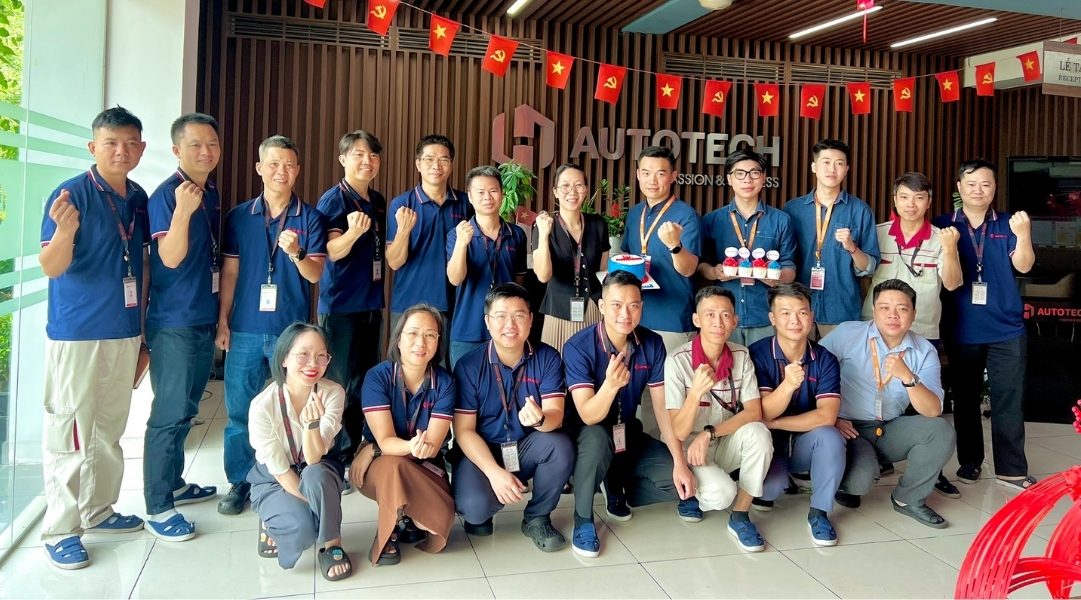
INNOCOM accompanies AutoTech in the Smart Factory AI ERP project
What is Smart Factory AI ERP?
Smart Factory AI ERP is a model that combines a smart factory, artificial intelligence (AI), and enterprise resource planning (ERP) to connect all production data, automate processes, and support real-time decision-making.
ERP serves as the central data management platform. Information about customers, quotations, sales orders, BOMs, procurement, inventory, production orders, costs, and human resources is stored on a unified system.
Smart Factory is responsible for collecting data directly from the shop floor. At each machine, workstation, or production stage, businesses can record production progress, output, material consumption, working time, product defects, and equipment status through QR codes, tablets, IoT sensors, or direct machine connections.
AI is the technology layer that analyzes this data to provide insights, alerts, and recommendations. Instead of requiring users to open multiple reports to search for information, AI can directly answer questions such as which projects are delayed, which production stages exceed labor-hour standards, or which supplier offers the most suitable option.
These three components do not operate independently. The value of Smart Factory AI ERP is realized when data from sales, design, procurement, inventory, and production is connected seamlessly across the entire operation.
Benefits of Smart Factory AI ERP for Businesses
Implementing Smart Factory AI ERP not only helps businesses digitize production processes but also creates a data-driven management foundation.
Centralized management of all enterprise data: Data from quotations, sales orders, BOMs, procurement, inventory, production, and accounting is connected on a single platform. This eliminates fragmented data, reduces duplicate data entry, and improves consistency across departments.
Improved operational efficiency and production productivity: Businesses can monitor production progress, output, machine status, and productivity in real time to quickly identify bottlenecks, allocate resources effectively, and optimize production capacity.
Faster and more accurate decision-making with AI: AI supports data analysis, trend identification, risk alerts, and recommended actions. This gives managers a solid data-driven basis for decision-making rather than relying solely on experience.
Better cost control and profit optimization: The system tracks material costs, labor costs, and other expenses by project or production stage, helping businesses identify budget overruns early and improve resource utilization.
Improved collaboration across departments: All departments work from the same data source, ensuring information is updated consistently, reducing handover errors, and shortening processing times.
Step-by-step development of a smart factory: Continuously accumulated data creates the foundation for expanding AI, IoT, and other digital technologies in the future, moving toward a modern and sustainable Smart Factory model.
These benefits demonstrate that Smart Factory AI ERP is more than an ERP system integrated with AI. It is a platform that helps manufacturers transform from traditional management methods to a smarter, more transparent, and data-driven operating model. This is also a critical factor in improving business competitiveness as modern manufacturing increasingly demands speed, accuracy, and adaptability.
Putting the Smart Factory AI ERP model into operation
How is a Smart Factory AI ERP different from a traditional factory?
The biggest difference does not lie in how many robots or sensors a factory has. The key lies in how the business uses its data.
Criteria | Traditional Factory | Smart Factory AI ERP |
Data Management | Data is scattered across paper documents, Excel files, and multiple software systems | Data is centralized and connected on a single platform |
Production Monitoring | Data is consolidated by shift or at the end of the day | Data is updated at each production stage in near real time |
Cross-Department Collaboration | Communication through email, Zalo, and separate files | Collaboration through standardized workflows |
Progress Management | Dependent on manual reports | Direct monitoring through dashboards and automated alerts |
Cost Control | Costs are consolidated after project completion | Budget and actual costs are compared throughout the process |
Material Management | Manual checks between inventory and production plans | BOM, inventory, procurement, and production orders are connected |
Procurement | Quotations are compared manually in Excel | AI supports extraction, standardization, and recommendation |
Decision-Making | Heavily dependent on individual experience | Combines experience with data and AI-driven analysis |
Equipment Maintenance | Periodic maintenance or maintenance after equipment failure | Abnormal signals can be analyzed for early warnings |
Continuous Improvement | Difficult to consolidate lessons learned across projects | Historical data can be reused to optimize operations |
Traditional factories typically operate reactively: a problem occurs, and then it is addressed. Smart Factory AI ERP enables a more proactive approach, where the system detects early signs of abnormalities and supports managers in taking action before problems become more serious.
Smart Factory AI ERP Transformation Roadmap for Businesses
Step 1: Assess the Current Operational State
Businesses should begin by assessing the processes of each department, from sales, design, procurement, and inventory to production and accounting.
The objective is to identify where data is generated, who is responsible for updating it, which steps require repetitive data entry, and where delays frequently occur.
Step 2: Identify Priority Business Problems
Businesses should prioritize issues that have the greatest impact on cost, schedule, or quality. For example, for project-based manufacturers, priorities may include connecting quotations, BOMs, procurement, and production orders.
Step 3: Standardize Processes and Foundational Data
Before integrating AI, businesses need to standardize material codes, project codes, units of measurement, BOMs, production stages, statuses, and approval rules.
If the same material exists under multiple codes or BOM data is incomplete, AI will struggle to generate reliable results.
Step 4: Design the Architecture and Workflows
The implementation team needs to design how data moves between modules, define access permissions, step-transition conditions, and approval responsibilities.
The architecture should also take into account integration with accounting software, machines, sensors, file systems, and other platforms currently in use.
Step 5: Implement Core ERP Modules
Businesses should first establish a complete operational flow instead of deploying systems across too many areas at once.
For example, a sample sales order should flow seamlessly from quotation, project, BOM, procurement, and inventory to the production order without requiring data to be re-entered across multiple systems.
Step 6: Connect Shop-Floor Data
Once management data is stable, businesses can begin collecting production data through QR codes, tablets, IoT devices, or machine connections. It is recommended to pilot the solution at a high-impact production stage or line to measure effectiveness before scaling up.
Step 7: Integrate AI and Continuously Improve
AI should first be applied to use cases with relatively clean data, such as information retrieval, document processing, quotation comparison, and delayed-progress alerts.
After accumulating sufficient data over time, businesses can expand AI applications to cost forecasting, production scheduling optimization, and predictive maintenance alerts.
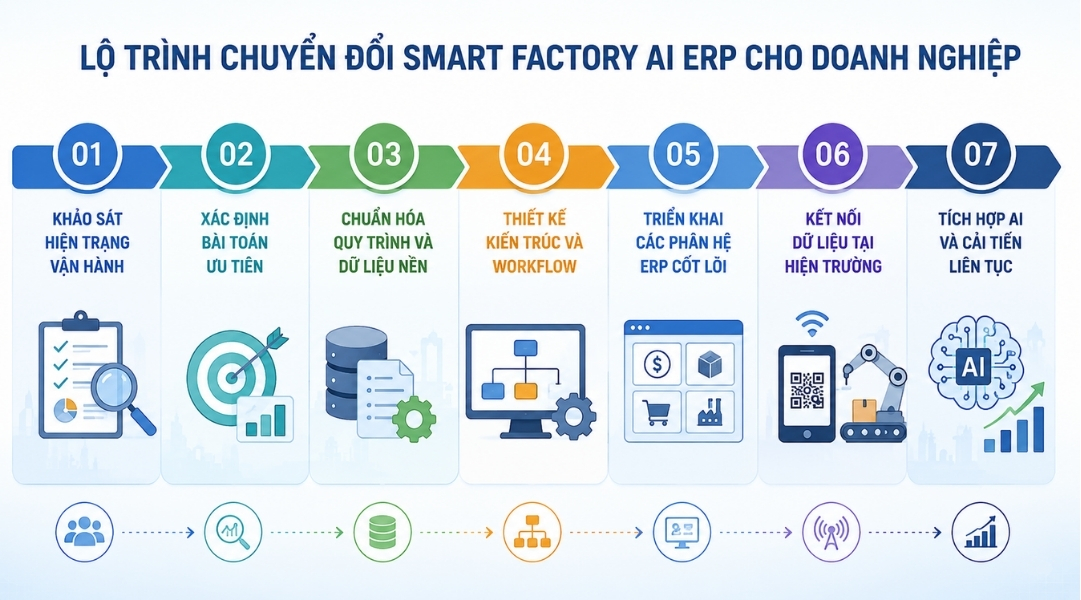
Smart Factory AI ERP transformation roadmap for businesses
Read more: ISA-95 standard: A comprehensive bridge in modern manufacturing
AutoTech and Innocom Officially Partner to Build a Smart Factory AI ERP Platform
To realize the Smart Factory AI ERP model, businesses need more than an ERP system or a standalone AI tool. They need a solution capable of connecting all operational data and processes on a unified platform. This is also the direction chosen by AutoTech Vietnam Machinery Manufacturing Joint Stock Company during its digital transformation journey.
As a machinery manufacturing company with many specialized processes, AutoTech aims to build a management system capable of connecting operations across sales, design, procurement, inventory, and production, while also applying AI to improve operational efficiency and support decision-making.
AutoTech Chooses Smart Factory AI ERP
As a machinery manufacturing company, AutoTech has consistently focused on investing in modern management solutions to strengthen operational capabilities and support future scalability.
During its digital transformation journey, AutoTech aims to build a management system that connects sales, design, procurement, inventory, and production on a single platform. At the same time, the company seeks to leverage AI more effectively to utilize data, reduce manual operations, and help managers make faster decisions.
This is also the direction many manufacturers are pursuing as ERP evolves beyond being merely a data management tool to become the foundation of a Smart Factory AI ERP model.
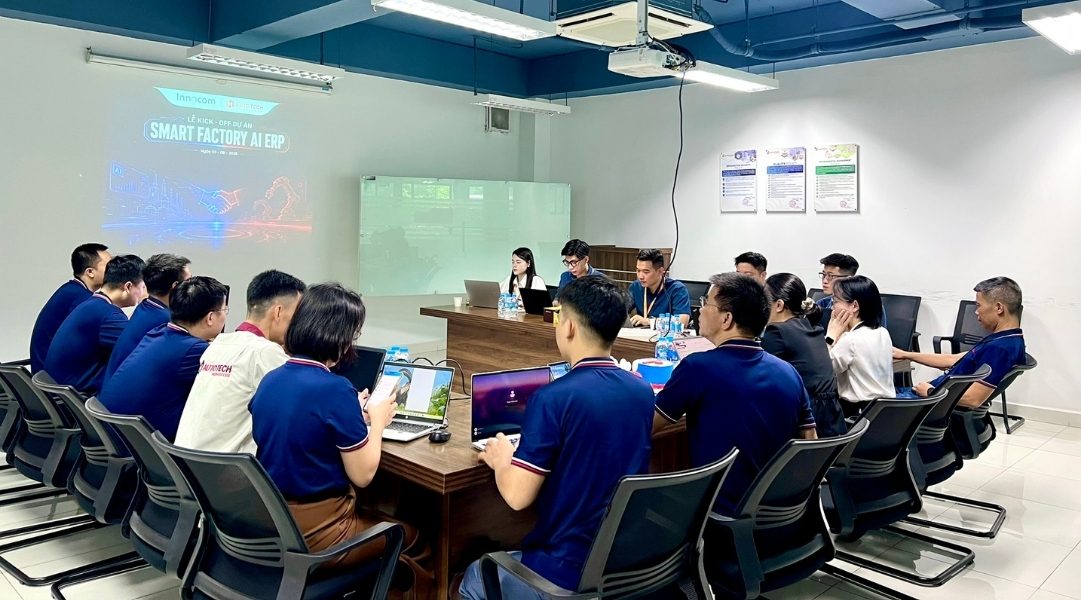
AutoTech chooses Smart Factory AI ERP
Innocom's Solution: Building Smart Factory AI ERP on the ABMS Platform
To achieve AutoTech's objectives, Innocom has officially signed and implemented a Smart Factory AI ERP project on the ABMS platform, combining AI Agents with Smart Factory technologies.
Instead of implementing another standalone software system, Innocom's approach is to build a unified management platform where all data is connected seamlessly from quotations, sales orders, projects, and BOMs to procurement, inventory, and production.

Smart Factory AI ERP solution from INNOCOM
The data flow is designed to connect:
Quotation → Sales Order → Production Order → Project → BOM → Inventory
At the same time, AI is directly integrated into business processes such as data retrieval, procurement support, technical document extraction, and production data analysis. AI features are designed around a human-in-the-loop mechanism, where AI acts as an assistant for analysis, while important decisions are still reviewed and approved by people before execution.
Through this project, Innocom continues to demonstrate its capability to implement Smart Factory AI ERP solutions for manufacturers, particularly for use cases that require the integration of ERP, AI, and specialized operational processes. At the same time, AutoTech has become one of the pioneering businesses adopting the Smart Factory AI ERP model to build a modern management platform that is ready for future growth and expansion.